

Freight Market Update: October 18, 2023

Trends To Watch

  • [Ocean – FEWB] EUR trade: In the last week, the market remains flat and rates continue at the $800 level. However, the spot price is down to $700. As expected, carriers are planning another General Rate Increase (GRI) starting on November 1st in order to cover operational costs. The first round of price increases has been announced between $1700 and $1800. Due to the GRI increases, there are expected to be more void plans (canceling sailings) if cargo recovery doesn’t improve in the coming weeks; For instance, after Ocean Alliance announced 5 more void plans for November, 2M Alliance followed suit, and announced 7 sailings to be voided in November during their Winter Program. MED trade: Following North European markets, a GRI has been announced for WMED pushing back up to $2000 levels. However, they are still seeing oversupply. Ocean Alliance has announced 6 more MED void plans to support the GRI in November, and there is an expectation that 2M & THE Alliance may follow.
  • [Ocean – TAEB] As capacity is starting to decrease, carriers are planning their first-rate restorations. We have seen announcements for rates to increase as soon as November 15th, 2023. Overall the on-time performance (OTP) is getting better and back to pre-pandemic levels around 70-75% of the time.
  • [Ocean – TPEB] October capacity has decreased as expected, however it is not as big a drop as was seen during CNY earlier this year. November’s outlook, on the otherhand, is still very healthy, but that has the possibility of changing. Demand ex-China has started to come online this week, bookings over the next 1-2 weeks will determine capacity for November. PN3 was discontinued from THE Alliance services for the foreseeable future. Expect healthy blanks, but overall capacity to be comparable to Q2/Q3.
  • [Air – Global] In September, global air cargo tonnage and rates increased compared to August. According to WorldACD Market Data, global air cargo had a rise of nearly +3% in tonnages and a +5% increase in rates. However, in week 39 (September 25 to October 1), there was a slight -1% drop in tonnages and a +2% increase in regional rates, the most notable increases were observed between the Americas, Europe, and Asia. Overall cargo capacity increased by 10% compared to the same period last year. Rates are now at $2.37 per kilo, which is 31% lower than last year but 38% higher than pre-COVID rates in September 2019.
  • [US Exports] TAEB: Transatlantic Eastbound (TAEB) capacity is decreasing due to canceled sailings and capacity cuts to transatlantic services. TPWB: Capacity is available from US Coastal Base Ports to China Base Ports and South East Asia’s Port of Delivery, but subject to continued canceled sailings. Inland Rail Ramps are reporting lower Excepted Quantity (EQ) levels due to reduced imports into the Midwest. If you’re booking a US export from a Rail Ramp, it’s advisable to book at least two weeks before the Cargo Receipt Date (CRD) to ensure EQ availability.


Source from Flexport.com
Freight Market Update: October 11, 2023

Trends To Watch

  • [Ocean – Europe] The European Commission (EC) has decided not to extend the Consortia Block Exemption Regulation (CBER) when it expires on April 25, 2024. In place since 2009, the CBER was designed to encourage competition in the shipping industry. What impact this will have on shipping to and from Europe remains unclear. (source: JOC)
  • [Ocean – Canada] Talks continue between representatives of the Port of Montreal Longshoremen’s Union and the Maritime Employers Association (MEA) as their current collective agreement expires on December 31, 2023. Longshoremen at the Port of Montreal are looking for wage increases of at least 20% over the next four years and full job security in three years, while the port operator is looking to limit how many workers get that level of security and a contract that guarantees union peace through the end of the decade.
  • [Ocean – TPEB] October capacity is down as expected with Golden Week, however it’s less of a drop than we saw during Lunar New Year (LNY). November’s outlook is good, but subject to change. Demand ex-China is just starting to come online this week, bookings over the next 1-2 weeks will determine capacity for November. Q4 outlook: Expect to see a good number of blank sailings, but with overall capacity comparable to Q2/Q3 numbers. The pre-LNY push will likely start in December. More new builds will continue coming online, carriers will most likely offset with more blanks and by moving smaller vessels to other markets.
  • [Air Freight – Global] In September, global air cargo tonnages increased by nearly 3% and rates rose by 5% compared to August, according to WorldACD Market Data. Despite this boost, September tonnages were still down 2% year on year, marking the smallest monthly YoY decrease in 2023.
  • [Ocean – FEWB] The market on the EUR trade remains flat. As expected, carriers are planning another round of GRI from Nov. 1, aiming to push up the market again to cover operation costs. Ocean Alliance announced 5 more void plans for November, in order to support the potential GRI carriers may plan more voids if cargo recovery is still not ideal from Mid-Oct. MED trade: Following NEUR, there’s also a GRI for WMED, but so far oversupply remains the case. Expect the market to drop further if the current round of voided sailings doesn’t lead to general strengthening.
  • [U.S. Exports] TAEB and TPWB are both seeing blank sailings impacting equipment levels at inland IPI locations. Please book 2+ weeks prior to CRD to ensure an optimal booking.

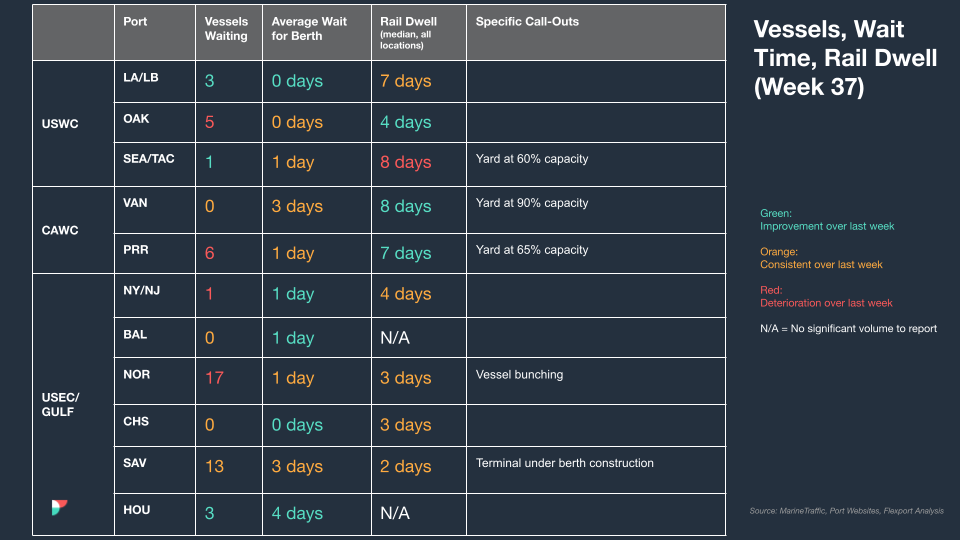
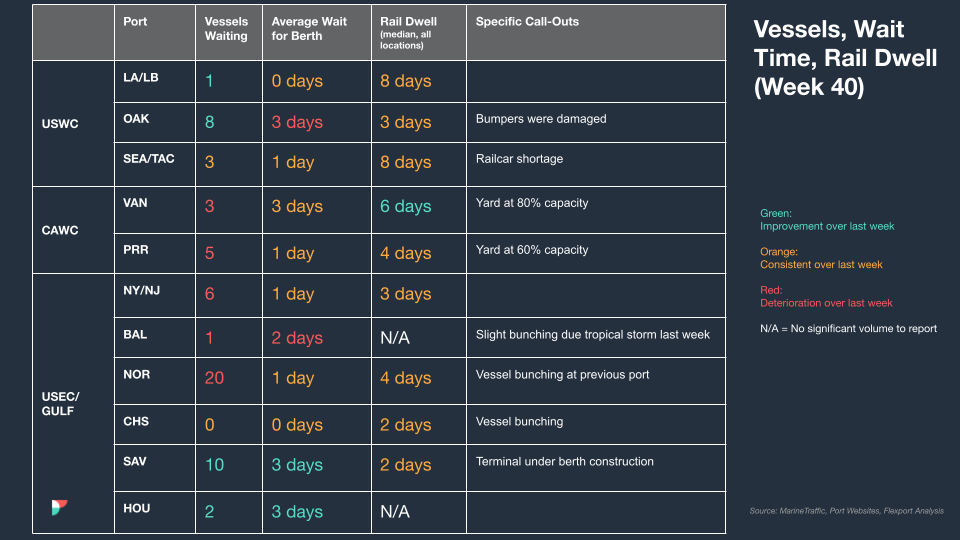
N. America Vessel Dwell Times

The Week In News

ILWU Dockworkers Union’s Sway at West Coast Ports Is Tested in Bankruptcy
In advance of a judgment against it for what a federal jury found to be illegal work stoppages at the Port of Portland in 2019, the International Longshore and Warehouse Union (ILWU) has declared bankruptcy. The ILWU represents more than 22,000 workers at 29 ports along the U.S. West Coast, and as such wields a significant amount of leverage when it comes to port operations and controlling the flow of goods entering and leaving the U.S.

IATA: First Air Cargo Demand Growth in 19 Months
As part of its August air freight analysis, the International Air Transport Association (IATA) released numbers showing that global cargo tonne-kilometers (CTKs) were up 1.5% year-on-year. At the same time, they showed CTKs being 1.3% below their pre-pandemic level in 2019. According to an IATA representative, “Air cargo demand grew by 1.5% over the previous August. This is the first year-on-year growth in 19 months, so it is certainly welcome news. But it is off a low 2022 base and market signals are mixed.”


Source from Flexport.com

Rail dwells rising along West Coast amid shortage of available rail cars

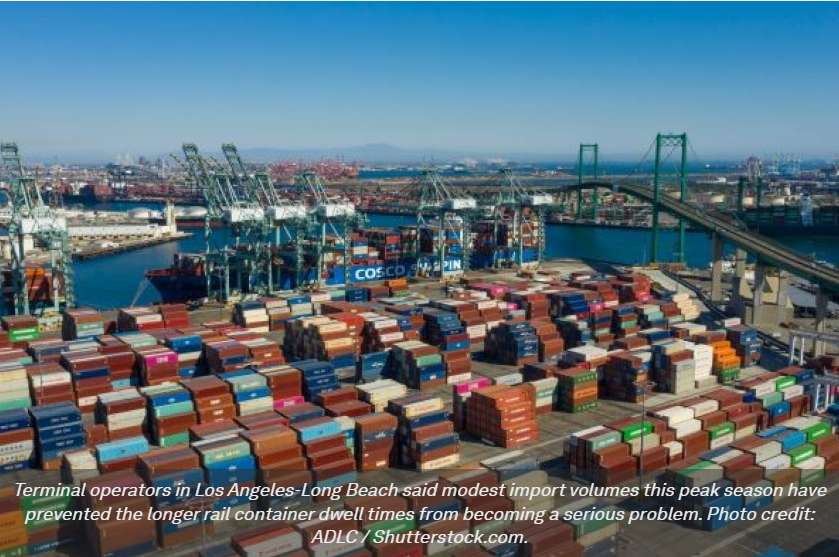
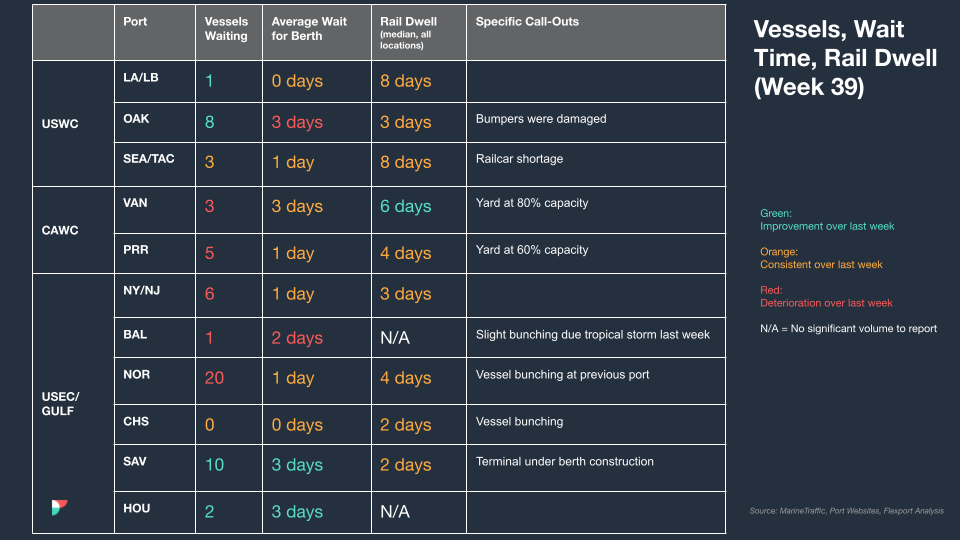
A shortage of rail cars is causing rail container dwells to rise at the ports of Los Angeles and Long Beach and in the Pacific Northwest, with operators unable to move inbound rail boxes off their marine terminals in a timely manner. While rail dwells have been slowly increasing since June, the problem worsened in September, sources say.


And a modest increase in pre-Golden Week import volumes last month contributed to the extended dwells, they said.


“We had some inventory buildup the last two to three weeks,” Alan McCorkle, CEO of Yusen Terminals in Los Angeles, told the Journal of Commerce Thursday. “(The railroads) are not positioning enough bare tables here.”


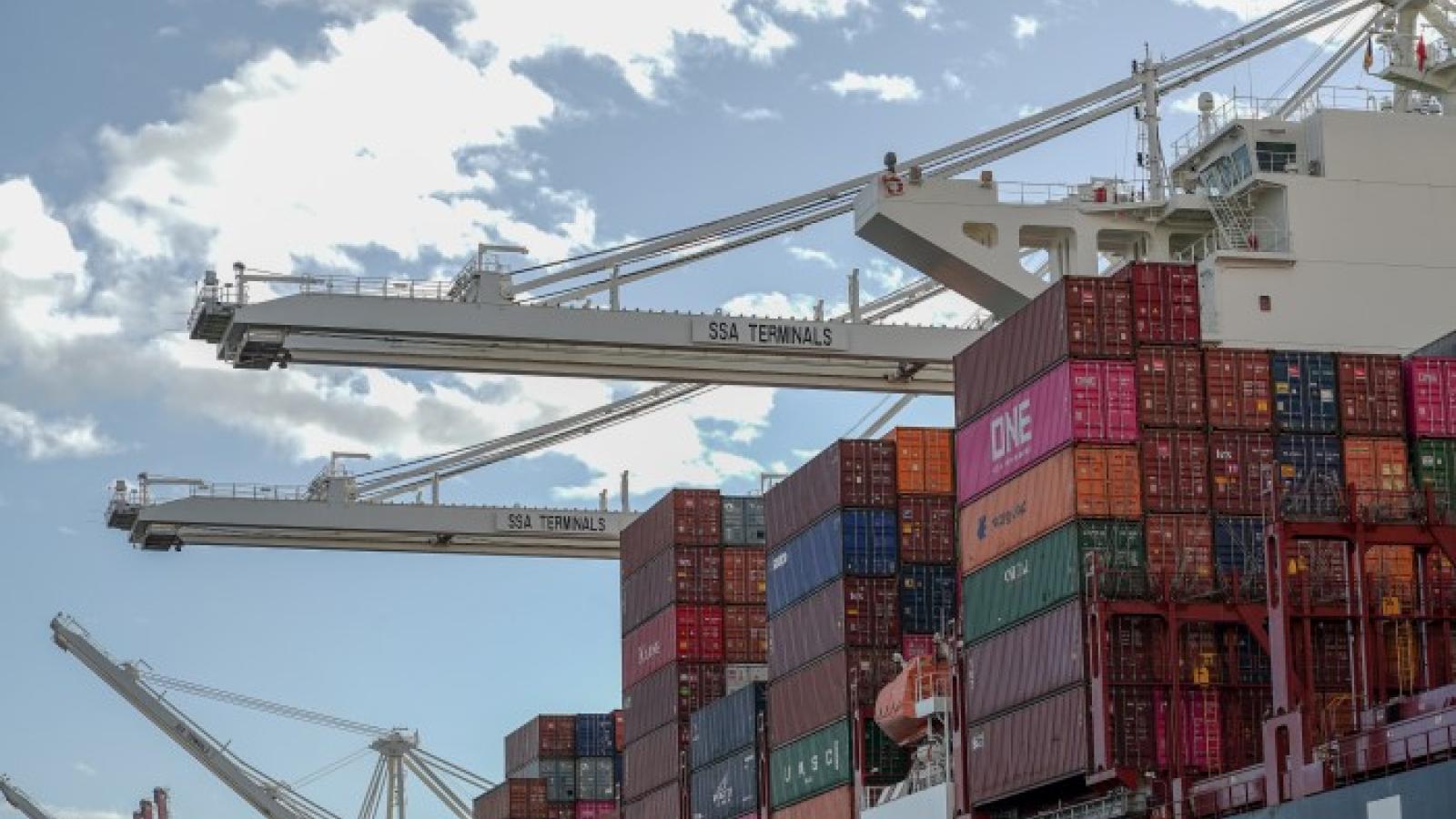
SSA Marine, which operates three terminals in Long Beach, said rail containers are dwelling longer on the docks because it doesn’t have enough rail cars to move the inbound loads to the US interior.


“There is a rail car shortage,” Ed DeNike, president of SSA Containers, told the Journal of Commerce. 


Despite the rising dwells, the congestion has not caused any disruption due to the manageable level of imports, even with the modest bump leading up to China’s Oct. 1-7 Golden Week and especially compared to the record volumes and vessel queues during the height of the pandemic.


“We’re not as busy, so there hasn’t been a big impact,” DeNike said.


Noel Hacegaba, deputy executive director and COO at the Port of Long Beach, said the current peak season volumes are likely contributing to the discrepancy between modestly increasing import volumes and weak export volumes, which is causing an equipment imbalance.


“The uptick in inbound cargo could be triggering rail equipment imbalances,” he said. “This is not across the board, but equipment balances are affecting some terminals more than others.”


Conditions expected to improve soon 


BNSF Railway said it is responding to the problem and that conditions should improve quickly.


“We experienced an increase in freight in transit in the San Pedro Bay Ports and responded quickly by increasing our international intermodal equipment fleet by 8% to meet the demand and our customers’ needs,” the railway said in a statement. “We are well-positioned to handle the business across our network with the additional assets as well as with capacity.”


Yusen is starting to see a difference this week. “It’s starting to clear up a little,” McCorkle said.


The Pacific Merchant Shipping Association (PMSA) has not yet released figures on September rail dwell times for Los Angeles-Long Beach. Dwells in August were 4.45 days, up from 4.14 days in July and 4 days in June. Just over 25% of the rail containers in August remained on terminal for five days or longer, up from 23% in June.


NWSA also seeing rail backups 


The shortage of rail cars is also an issue in the Pacific Northwest. “Rail car availability is currently a serious concern due to the low volume of cars heading westbound to balance the high volume going eastbound,” Hapag-Lloyd said in a Sept. 29 customer advisory about the ports of Seattle and Tacoma.


The Northwest Seaport Alliance (NWSA) said in a statement to the Journal of Commerce that the two ports have seen an increase in container volumes over the past several weeks, and that it has caused “temporary congestion for intermodal cargo at some of our terminals.” It said the railroads will be sending in extra cars to alleviate the backlog.


“Our operations team has been working closely with the Class I railroads and we’re pleased that both have responded with additional support and are sending extra equipment,” the NWSA said. “We expect the terminals to recover fully within a few weeks.”


The delays appear to be highest at Tacoma-area terminals, according to the advisory, which said Husky Terminal is seeing import dwells of just over seven days due to the railcar imbalance. The neighboring Washington United Terminal is seeing delays of three to seven days, while Seattle’s T18 terminal is experiencing one- to three-day dwells.


Union Pacific, which runs the Tacoma South Intermodal Terminal, did not respond to a request for comment.


While international import and export container volumes are down a combined 25.6% as of August on a year-to-date basis relative to 2022, a logistics manager who asked not to be identified said there had been some rush to bring in goods ahead of the Golden Week holiday. The source said her company’s roughly 250,000 square feet of transload space is at capacity as shippers elect to move goods via dry-van trailer.


“Tacoma transloads are full,” the source said. “Maybe it’s issues at the Panama Canal, maybe people need to bring in time-sensitive goods right now.”


The Pacific Northwest is about to see ocean carrier capacity drop further in the coming weeks, so shippers could be trying to get ahead of that. THE Alliance is suspending its PN3 service to Seattle-Tacoma indefinitely following the last sailing from Asia Oct. 8.

THE Alliance said the lack of demand was behind the need for the service cut. Along with THE Alliance, Ocean Alliance’s OPNW-Dahlia service is running fortnightly through October.


But the logistics manager said the service cuts set up a vicious cycle where shippers decide to use other ports due to the lack of reliable and consistent ocean service. With the service cuts and schedule irregularity, the source said shippers are having problems returning empty containers. As fewer ships are able to take out empties, the manager said truckers sometimes face two- to four-hour turn times, including time in the queue outside the gates, and vessel cutoffs for exports have occasionally been missed.


“They need to fix the gates, fix the queues and extend some hours,” the source said. “We need to bring consistency back to this gateway so it doesn’t lose more cargo to other ports.”


Source from JOC.com

Freight Market Update: October 4, 2023

Trends To Watch

  • [Weather – Asia] Typhoon Koinu is currently centered east of Southern Taiwan and is forecast to move west-northwest over the next several days. The typhoon is forecast to make landfall in southern Taiwan by the morning of Oct. 5 and continue to move westward across the Southern Taiwan Strait through Oct. 8 while weakening to a tropical storm. Air impacts: Starting on the night of Oct. 4 there will likely be flight delays and cancellations across Taiwan as the typhoon approaches, these delays will persist through Oct. 5 as the system moves westward over Southern Taiwan. Ocean impacts: Starting on Oct. 4 there will likely be vessel delays, especially in the south of Taiwan, with port closures likely at Kaohsiung. These delays/closures will persist through Oct. 5 before conditions return to normal as the system continues westward. As the storm moves westward across the Southern Taiwan Strait between Oct. 5-7 vessels transiting north/south along East China could be impacted.
  • [Ocean – FEWB] EUR trade: With soft demand and Golden Week impact, rates continue to drop. Ocean Alliance has announced 5 more void plans for Nov, the other alliances may still announce their own void plans even full service take-out over the rest of year. MED trade: demand has become weak, matching North Europe and there have been blank sailing announcements from all 3 alliances. Rates keep dropping and the spot rate is open again for WMED.
  • [Ocean – TAEB] New blank sailings across the trade and further reduction of contract rates is demonstrating the widely available capacity from U.S. coastal ports and Midwest rail ramps.
  • [Ocean – LATAM] Due to the ongoing drought situation in the Amazon region, ocean carriers have announced a Low Water Surcharge for all cargo going in and out of the Port of Manus in Brazil. Other carriers have pulled their service completely. Rio Negro’s water level fell by an average of 30 centimeters (11.8 inches) a day since mid-September and stood at 16.4 meters (54 feet) last week, approximately six meters below its level the same time last year.
  • [Air – Global] While general air cargo tonnage has seen a decline year-to-date, special air cargo product verticals have experienced growth according to WorldACD Market Data analysis. Despite a 7% drop in total worldwide chargeable weight from January to August 2023 compared to the same period in 2022, specific product categories such as vulnerable/high tech, live animals, perishables, and valuables have shown notable growth, with special cargo products overall growing by 3%.

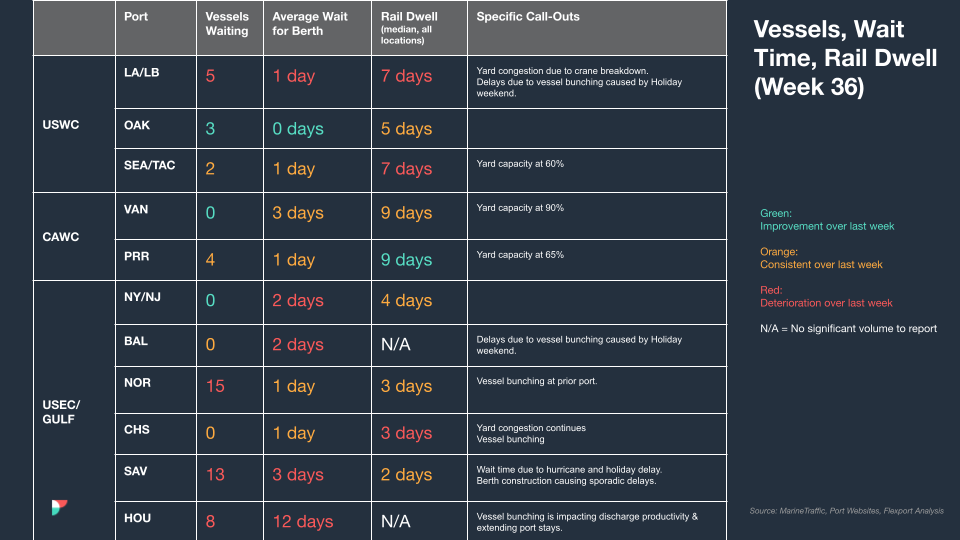
N. America Vessel Dwell Times

The Week In News

[VIDEO] Watch: How COVID Changed the Shipping Industry — Forever

Innovations developed during the height of the pandemic are helping ecommerce logistics stay attractive to consumers who became accustomed to package tracking, easy returns, and more. This according to Jakki Krage Strako, Chief Commerce and Business Solutions Officer with the U.S. Postal Service. Consumers have taken their expectations back to the office and remain loyal to companies who provide the best support and service.

FMCSA Will Award $44M To Improve CDL Processes

The money is intended to help streamline the process of training and onboarding badly needed new drivers by increasing staffing at Commercial Driver License (CDL) training centers, improving cross-state reporting, and other moves to help bolster the supply chain. According to Transportation Secretary Pete Buttigieg, “With these grants, we are helping states bring more well-trained drivers into this essential field, strengthening our supply chains for years to come.”


Source from Flexport.com

More trans-Pac service cuts on tap for October as carriers seek to buoy rates

THE Alliance’s suspension of a trans-Pacific service next month adds to the raft of canceled sailings and other service changes that ocean carriers have planned now through well into October as they attempt to better balance ship supply with import demand.


Hapag-Lloyd on Wednesday said the Pacific Northwest 3 (PN3) service it operates under its alliance agreement with Ocean Network Express, Yang Ming and HMM will be suspended following an Oct. 8 sailing from Hong Kong due to the “present market situation.” In place of the PN3 service, the carrier said its PN2 service would add calls to the Asian ports served by the PN3.


THE Alliance has already announced a series of service changes in September. Over the next three weeks, it plans to blank 12 sailings – two to the Pacific Northwest, five to Southern California and four to the US East Coast – accounting for nominal capacity of 119,000 TEUs.


The 2M Alliance partners Mediterranean Shipping Co. (MSC) and Maersk also announced this month that 11 trans-Pacific voyages scheduled between Sept. 25 and Oct. 9 will be blanked, accounting for 108,000 TEUs in nominal capacity. Those include four services to Southern California ports, six to the US East Coast and one to the Gulf Coast.


In addition, schedules from carriers of the Ocean Alliance show changes to sailing frequency or outright cancellations on 17 services through the end of October with nominal capacity of 146,000 TEUs. Cosco Shipping and Orient Overseas Container Line will offer fortnightly, in place of weekly, sailings on their 5,800-TEU Dahlia service to the Pacific Northwest through October. Evergreen Marine will also offer biweekly sailings on its 12,000-TEU Southwest Express Service to Los Angeles through October in place of weekly service.


Blankings will ‘get worse’ 


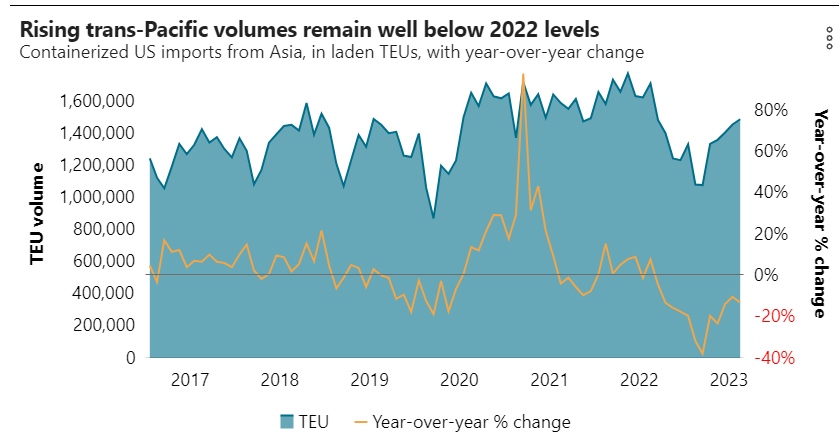
With Asian imports to the US down 20% year-to-date, the trans-Pacific is bearing the brunt of service cuts. Maritime consultancy Drewry’s canceled sailings tracker indicates that the trans-Pacific will account for 59 of 104 canceled sailings worldwide originally scheduled between mid-September and the end of October.


Drewry added that with service cuts and schedule changes coming fast, “shippers and (beneficial cargo owners) are advised to remain attentive, as these developments could potentially result in schedule disruption and delays in cargo movements.”


An import manager who oversees 10,000 FEUs in Asian imports, primarily through West Coast ports, told the Journal of Commerce she is seeing about 5% of her inbound volumes get rolled to later sailings due to the service changes. The source, who did not want to be identified, expects the increase in blank sailings through October will mean that shippers who have booked cargo for sailings that month will likely face more delays as capacity tightens.


“Some of the carriers are blanking a lot,” she said. “The second half of September is tough, but the first half of October is going to be a mess. It’s going to get worse before it gets better.”


James Caradonna, vice president at MCL-Multi Container Line, told the Journal of Commerce that the capacity cuts – most of which are in response to China’s Golden Week holiday – have managed to stem further slides in spot freight rates in the near term, while keeping ships full.


While spot rates are very fluid, he said current market levels of $1,600 to $1,900 per FEU to the US West Coast at least allow the carriers to break even, particularly as fuel costs begin to rise.


“Those rates are not bad in a historical context,” Caradonna said. “I think many carriers would be okay with having rates in that range.”


He estimates that vessel utilization to the Southern California ports is over 90%, with some cargo being rolled to the next available voyage, as schedule changes and blank sailings prompt shippers to go with the fastest and highest-capacity ocean services available. In contrast, load factors on ships to the Pacific Northwest are around 80% as cargo flow at Canadian ports returns to normal following labor unrest in July.


“Load factors to Southern California have not been terrible,” Caradonna said. “Capacity has been more constant to the Pacific Southwest than the Pacific Northwest.”


Vessels going to the US East Coast are also likely seeing utilization around 80% or sometimes lower, according to Caradonna. He said the lower usage reflects a shift of some import cargo back to the West Coast after the ratification of the longshore labor contract and concerns about delays at the Panama Canal. Spot rates to the US East Coast have fallen harder than those to the West Coast, and now hover around $2,300 to $2,500 per FEU.


Source from JOC.com

Freight Market Update: September 20, 2023

Trends to Watch

  • [Ocean – FEWB] With soft demand and the expected impact of Golden Week, FAK rates continue to drop prior to the Golden Week holiday. Capacity cut for October is estimated to be 20-30%. On the Mediterranean trade demand has weakened and more blank sailings have been announced from all 3 alliances.
  • [Air – Global] Overall market demand for air freight capacity is on the increase — particularly from Asia to the U.S. and Europe. South East Asian countries such as Thailand, Vietnam, Singapore and Malaysia are most impacted with surging demand levels due to consumer electronics and semiconductor production. At the same time, China and Hong Kong are experiencing rising demand levels due to ecommerce activity and New Product Introduction (NPI). Because all of this volume routes through 3 primary export gateways in Asia—HKG, PVG, and TPE—capacity is impacted resulting in extended transit times and rising rate levels.
  • [U.S. Exports] US Export trades remain wide open with all carriers aggressively pursuing volume and pricing accordingly. Filling the backhaul remains a top priority and low rates reflect this aggressive push for market share accordingly.
  • [Ocean – ISC > U.S.] Ocean freight demand ex India has softened in September resulting in carriers dropping rates. Drop in demand is expecting to persist through the first half of October.
  • [Ocean – LATAM] Space remains open both northbound and southbound—and both to and from both coasts. Brazil exports: Vessel utilization at a very healthy level (~90-95%). We recommend placing bookings 4-5 weeks prior to CRD.


Wider Trends Worth Watching:

  • Some shippers are beginning to restock after selling through last year’s overstocks, leading carriers to continue expecting a muted peak season using small gains around back-to-school and Halloween as guideposts.
  • Mexico is seen as a growing market due to the nearshoring trend continuing to expand. Yard capacity south of the border at Laredo continues to grow and more rail links are being established.
  • Shipping into the USWC is rebounding after uncertainty around labor actions and congestion in the first half of the year. Delays at the Panama Canal are a contributing factor, as are the lower rates compared to the U.S. Gulf Coast/USEC.

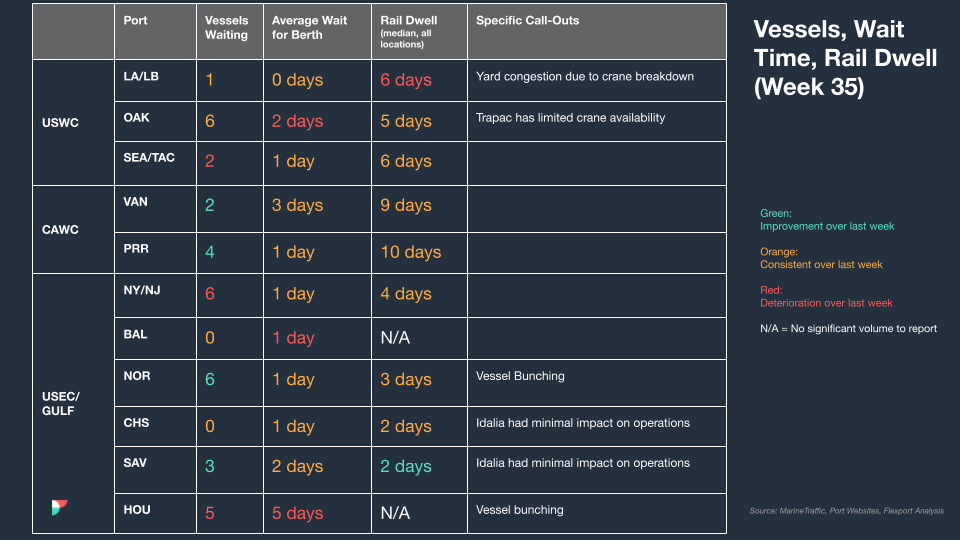
North America Vessel Dwell Times

This Week In News
 
[VIDEO] How the Panama Canal’s Drought Is Threatening Global Supply Chains


Ongoing drought conditions in the region have led the Panama Canal Authority to impose several layers of restrictions on vessels transiting this crucial sea route. This 10-minute explainer video does a good job of summarizing the situation while introducing additional context and background to ensure viewers are seeing the whole picture.

Port of Long Beach Sees Modest Start to Peak Shipping Season

According to the NRF, 2023 container imports to the U.S. will hit 22.3 million TEUs, down ~12.5% from last year yet up from the 22 million seen in pre-pandemic 2019. Numbers at the Port of Long Beach as we enter peak season seem to support that prediction, seeing 682,312 TEUs last month, a decrease of 15.4% from August 2022, but an increase of 18% over July.

Source from Flexport.com

Freight Market Update: September 13, 2023

Trends to Watch

  • [Ocean – TAWB] Some carriers have announced withdrawal of capacity ex North Europe to US East Coast as the demand hasn’t picked up enough to justify the additional capacity—leading to the expectation that rates will bounce back from the beginning of November. Some additional capacity might enter the Mediterranean to Canada market, Ocean Alliance should announce this soon.
  • [Ocean – LATAM SB] Exports overall are down 20% since the same time last year. Since the beginning of the year, MSC has been losing market share and as a result they have proactively decreased Q4 rates to West Coast South America in an attempt to regain market share. Although they have decreased rates, they are still above other ocean carriers in the market.
  • [Ocean – LATAM > Canada] Crowley (niche LATAM carrier) recently announced the launch of a new service in partnership with CN rail that connects Mexico and Canada with a weekly ocean/rail combination between the port of Tuxpan, MX and Mobile, AL with a 2.5 day TT. This service is starting Nov 7 and they will offer dry and reefer services. This is targeting businesses that traditionally relied on FTL services connecting MX-Canada (west coast) and/or slower ocean transits connecting MX Gulf to Canada EC.
  • [Ocean – U.S. exports] TAEB: Rates are rising out of Houston to north Europe base ports related to increased cargo routing through Houston via rail.
  • [Ocean Ports – USEC] Hurricane Lee is moving up the US East Coast and approaching Canada. Expect vessel arrival days as the storm passes each port. The Port of Halifax, Canada, is closely monitoring the storm. Vessel delays to the port are highly likely.
  • [Ocean – TPEB] September capacity overall at ~85%, a 5% increase from August and the 2nd highest month for total capacity this year. No further drop in capacity for September is expected. Vessel plans will remain in lead up to Golden Week (1 October) Golden Week closures expected to begin September 25/26, with most factories closed Sept 23 – Oct 8.

North America Vessel Dwell Times

This Week In News
Flexport Launches a Revolution to Democratize Supply Chain for Entrepreneurs

This week, Flexport launched a supply chain revolution for entrepreneurs, the first truly all-in-one tool and end-to-end global trade solution powering instant access to financing, freight, fulfillment, and replenishment to all major marketplaces and retail stores. Those who want even more can join Flexport+, a membership program offering exclusive access to industry-leading supply chain financing, priority shipping services, and easy access to supply chain experts for heightened support.

NRF acquires Reverse Logistics Association

In a move to help its members establish and meet full-circle sustainability goals, The National Retail Federation (NRF) recently announced it had acquired the Reverse Logistics Association (RLA). With the continued growth in consumer demand for a true circular economy and visibility into what happens to goods after return, the NRF says they’re now better positioned than ever to support their members in meeting these demands as well as assisting with the growing issue of returns fraud.


Source from Flexport.com

Freight Market Update: September 6, 2023

Trends to Watch

  • [Ocean – LATAM Northbound] ONE has introduced their new service, the FLX service, which will call at: Callao – Paita – Guayaquil – Cartagena – Port Everglades – Puerto Cortes – Cartagena.
  • [Ocean – TPEB] Carriers continue blank sailing programs as import volumes remain uncertain. This could put a space crunch into the market as we approach Golden Week.
  • [Ocean – ISC>N. America] Operations have normalized across ports in northwestern India. Overall demand is down YoY in terms of the value of goods shipped. Volume in terms of TEU down ~14% Jan – July YoY. Watch for blank sailings in September due to lower demand from India to southeast U.S. ports such as Savannah, Charleston, and Norfolk.
  • [Regional – LATAM] Brazil exports are on the rise and GRIs are being implemented by all major ocean carriers. We expect volume to continue increasing into Q4 and recommend booking 4+ weeks ahead of sailing.
  • [Regional – U.S.] Rain in the US Southwest continues to impact rail and road traffic. Shipments moving from California ports into the Southwest and Texas can expect to see 2-3 day delays in transit times. We are keeping an eye on Tropical Storm Lee which formed in the Atlantic and is forecast to become a major Hurricane. Earliest impacts to shipping would be the end of next week.
  • [Air – Mode update] Air cargo volumes have continued to decrease through the year, narrowing to their lowest level as of July. This indicates that the market is showing signs of bottoming out, though analysts say that strengthening demand shows reason to be cautiously optimistic.

North America Vessel Dwell Times

This Week In News
ILWU Ratifies 6-Year Contract

With a 75% majority, the International Longshore and Warehouse Union (ILWU) ratified a new 6-year contract with the Pacific Maritime Association (PMA) this week. The contract will retroactively start on July 1, 2022 (when the previous contract expired) and extends through July 1, 2028. The ratification comes at the end of a 13-month process that included labor actions, fears of a strike that could have severely hampered the U.S. supply chain, and multiple rounds of negotiations between the two parties. The contract affects 22,000 dock workers at 29 ports up and down the U.S. West Coast.

Chatbots Are Trying to Figure Out Where Your Shipments Are

Since OpenAI launched ChatGPT in November of last year, more companies have started investigating ways to use Generative AI, the technology that powers this and other recently launched tools, in their customer service and other public-facing aspects of their business. Artificial intelligence has been making its way into the backend of the industry for several years already, but the ability of generative AI to quickly parse data and respond to humans in a human-like manner has companies looking at ways to lighten the workload on their external-facing employees as well.


Source from Flexport.com

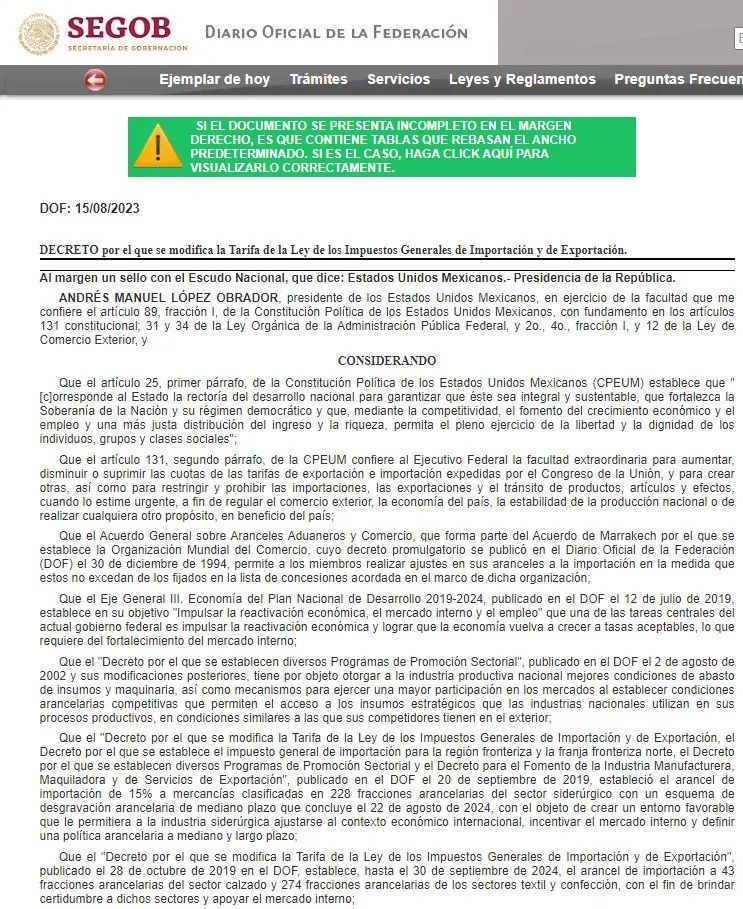
墨西哥上调392个项目进口关税,90%产品高达25%

2023年8月15日,墨西哥总统签署法令,自8月16日起,上调钢铁、铝、竹制品、橡胶、化工产品、油、肥皂、纸张、纸板、陶瓷制品、玻璃、电气设备、乐器和家具等多种进口产品的最惠国关税。
该法令将适用于392个关税项目的进口关税提高。这些关税项目中的几乎所有产品现在都适用于25%的进口关税,只有某些纺织品将适用于15%的关税。这一进口关税率的修改于2023年8月16日生效,将于2025年7月31日结束

关于在法令中列出的具有反倾销税的产品中,来自中国和中国台湾地区的不锈钢;中国、韩国的冷轧板;中国和中国台湾地区的涂层扁钢以及来自韩国、印度和乌克兰的无缝钢管等进口都将受到这一关税增加的影响。
该法令将影响墨西哥与其非自由贸易协定贸易伙伴之间的贸易关系和货物流动,其中影响最大的国家和地区包括巴西、中国、中国台湾地区、韩国和印度。但是,与墨西哥有自由贸易协定(FTA)的国家不受这项法令影响。
由于此次关税上调预先毫无征兆,并且墨西哥官方公告语言为西班牙语,以墨西哥为出口市场和转移投资目的国的中国企业,将会受到相当程度的冲击。
墨西哥是中国在拉美地区的第二大贸易伙伴;中国是墨西哥全球第二大贸易伙伴。两国经贸合作潜力巨大。自2018年开始的中美经贸摩擦以来,全球供应链发生了深刻的转变。CPTPP和USMCA等区域自贸政策安排,也促动中国企业对墨西哥进行日益提升的跨境转移投资。墨西哥上调对华进口关税,不利于墨西哥承接中国的产业和供应链转移。
近92%产品征收25关税,哪些产品受影响最大

根据我国海关总署发布的相关数据统计,中国对墨西哥商品出口从2018年至2020年间的440亿~460亿美元的水平,增至2021年的669亿美元,2022年进一步增至773亿美元;2023年上半年,中国对墨西哥商品出口金额已经超过392亿美元,与2020年以前的数据相比,出口增幅近180%。根据海关数据筛选,墨西哥法令所列的392个税号涉及的出口金额约为62.3亿美元(以2022年数据为基础,考虑到中墨海关税号存在一定的差异,实际受影响的金额暂时无法精确统计)。

其中,进口关税税率调增分为5%,10%,15%,20%和25%五档,但有实质性影响的,集中在“8708项下挡风玻璃及其他车身附件”(10%)、“纺织品”(15%)和“钢铁、铜铝贱金属、橡胶、化工产品、纸类、陶瓷产品、玻璃、电器材料、乐器和家具等”(25%)等产品大类上。

392个税号共涉及我国海关税则类别的13个大类,受影响最大的依次是“钢铁及钢铁制品”、“塑料和橡胶”、“运输设备及零件”、“纺织”和“家具杂项”。这五大类在2022年对墨出口金额占总出口金额的86%。这五大类产品也是近年来中国对墨出口增长明显的产品类别。此外,机械器具、铜镍铝和其他贱金属及制品、鞋帽、玻璃陶瓷、纸类、乐器及零件、化工、宝石贵金属也比2020年有不同程度增长。

以我国对墨西哥出口的汽车零配件为例,据不完全统计(中、墨税则不完全对应),此次墨西哥政府调整的392个税号中,2022年与汽车产业相关的税号商品,中国对墨出口额占当年中国对墨出口总额的32%,达19.62亿美元;而2023年上半年同类汽车产品对墨出口额达11.32亿美元。根据业内人士估计,中国在2022年平均每个月向墨西哥出口3亿美元汽车零部件。即2022年中国对墨西哥汽车零部件出口金额超过了36亿美元。二者的差异主要是因为还有相当一部分的汽车零部件税号,墨西哥政府此次没有纳入到进口税增加的范围内。

▼11月6-8日,货代两会-相约上海陆家嘴

中国海关统计数据显示,电子、工业机械、车辆及其零附件是墨西哥自中国进口的主要产品。其中,车辆及其零配件产品的增幅较为典型,2021年同比增长72%,2022年同比增长50%。从具体产品上看,2022年中国对墨西哥出口货运机动车辆(4位海关编码:8704)同比增长353.4%,2021年同比增长179.0%;机动车辆的车身(4位海关编码:8707)2022年同比增长165.5%,2021年同比增长119.8%;装有发动机的机动车辆底盘(4位海关编码:8706)2022年同比增长110.8%,2021年同比增长75.8%;等等。

须要警惕的是,墨西哥此份增加进口关税的法令,不适用于与墨西哥签订了贸易协定的国家和地区。从某种意义上说,这份法令,也是美国政府推行“友岸”供应链大策略(friendshoring)的一个最新体现。

全球汽车产业链紧密相连,中国汽车零部件供应商可以向墨西哥的任何海外公司供货。然而,墨西哥增加进口关税可能对中国汽车零部件出口企业产生较大影响。虽然美国正在采取措施削弱中国的影响力,中墨汽车贸易规模呈快速增长趋势,但不能简单地认定中国汽车产品出口墨西哥的目的是为了借道向美国出口。该观点只是美国通过《美墨加协定》来布局供应链的导向性作用。实际的贸易流动受到多种复杂因素的影响。

转载自“海运网”

‘Rushed’ sourcing shift out of China prompts some reconsideration

SINGAPORE — “China plus-one,” “friend-shoring” and “reshoring” may be catchphrases of the day, with the underlying trends they describe being well-supported by macro-level trade data. But as sourcing shifts out of China due to risk mitigation and other factors, one thing is increasingly apparent: Moving production out of China is costly, even to the point of leading some to reconsider it.


The reality is that for any number of product categories, relocating sourcing brings with it less efficient logistics, occasional lower quality, and overall higher costs at a time when cost control is rapidly assuming a higher priority for shippers.


That is why some executives with long experience in Asia logistics believe that if factors like risk mitigation were to recede as an urgent supply chain priority — for example, if there were to be a de-escalation of geopolitical tensions — China could, at least in the short term, recapture lost manufacturing given the well-established efficiency and quality of its overall system.


“The short-term rush out of China has in some cases been too rushed and infrastructure/cost and capabilities were not ready to absorb the business from China and thus if there were immediate changes in China; some of that would likely come back as an interim step,” said a senior Asia-based forwarding executive.


However, “two to three years more of fixing the bugs in the new countries will make that reversal much less likely,” he added, reflecting a view that diversification of supply firmly remains a long-term trend.


Still, it’s not happening without bumps in the road. According to anecdotes shared with the Journal of Commerce by a freight forwarder, such frustrations led a white goods manufacturer who had a pre-COVID sourcing split of roughly 40% Thailand, 33% Vietnam and 17% China to “actually (go) back to China for a significant amount of sourcing.”


Three specific reasons were cited: a more dependable supply chain for raw materials and parts, less tangled transportation solutions out of Asia, and sourcing capacity – especially following the surge in demand during the pandemic.


Issues in Vietnam led a footwear and apparel maker to acknowledge the pain associated with transitioning from a 57% China/29% Vietnam split to 45% China/35% Vietnam today. “Ocean capacity is a major issue,” for the shipper, the forwarder said.


“From a transportation and lead time angle, [the company was] much better off in Xiamen, which can boast over five times [the] direct call capacity than Haiphong.”


A seller of artificial Christmas trees, meanwhile, was sourcing 93% of its product from China as of 2019, but as of 2023 is sourcing 58% from China and 41% from Cambodia. However, the forwarder said, “they do not see a further shift away from China as they also cited capacity and supply chain efficiencies from China were still far superior than those in Cambodia.”


“Not surprisingly, priority [purchase orders] … are still coming from China as they do not have enough confidence that the factory, infrastructure or transportation options from Cambodia can deliver consistently,” the forwarder source added. “Also worth noting that as a result of the shift, this particular importer has had to push up its shipping program for Christmas trees, and rather significantly at that.”


Sourcing shift comes with new costs 


study prepared for the annual US Federal Reserve Jackson Hole Symposium held from Aug. 24-26 found that moving production out of China brought additional cost.


“Decreases in product-level import shares from China are associated with rising unit values for imports from Vietnam and Mexico, which likely reflects rising costs of production in these locations,” the study concluded. “This ongoing reallocation of global supply chain activity comes attached with costs that need to be monitored and assessed more rigorously.”


Part of the additional cost stems from less-efficient logistics, including fewer direct connections that result in more frequent transshipments, as well as chronically congested terminals and inland connectors. Sources say companies buying from factories are likely to experience more problems than large industrial companies that make a long-term commitment to a new market by establishing their own production and associated supply chains.


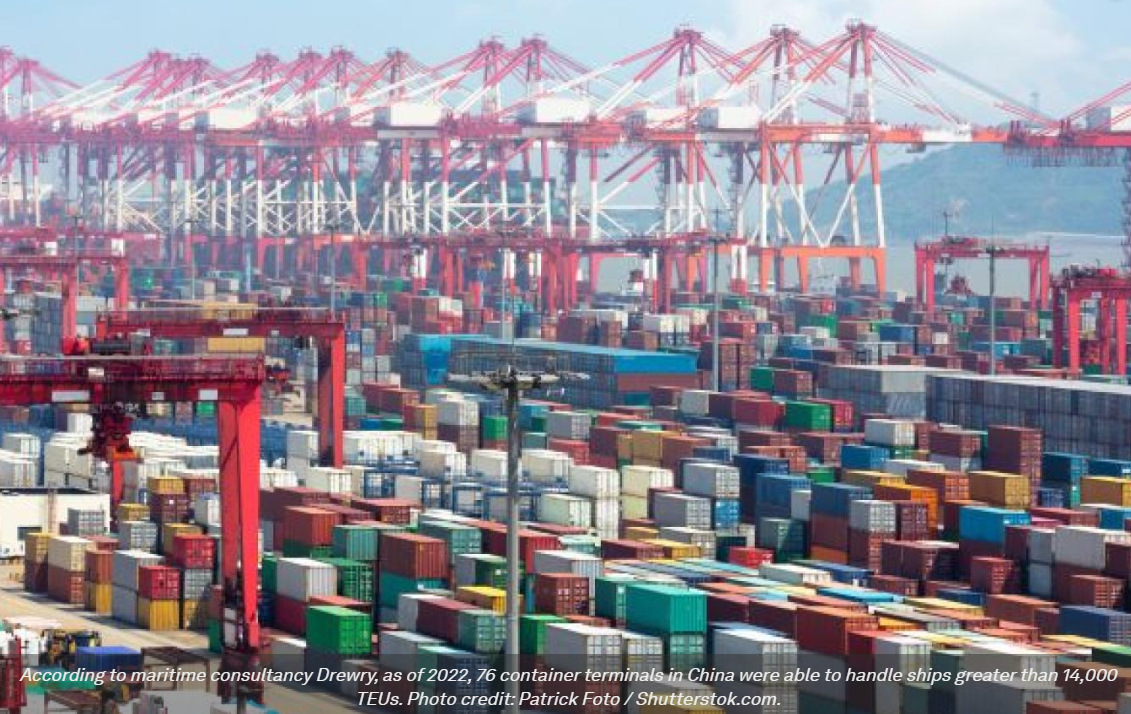
Part of the underlying issue is that transportation infrastructure is well known to be far less developed throughout Southeast Asia, even if it’s expanding rapidly across the region. According to maritime consultancy Drewry, as of 2022, 76 container terminals in China were able to handle ships greater than 14,000 TEUs, while there were only 31 across south and southeast Asia. China is the only country in the world to have built significant container port capacity ahead of demand, while in other developing countries new terminals fill up almost immediately after they open.


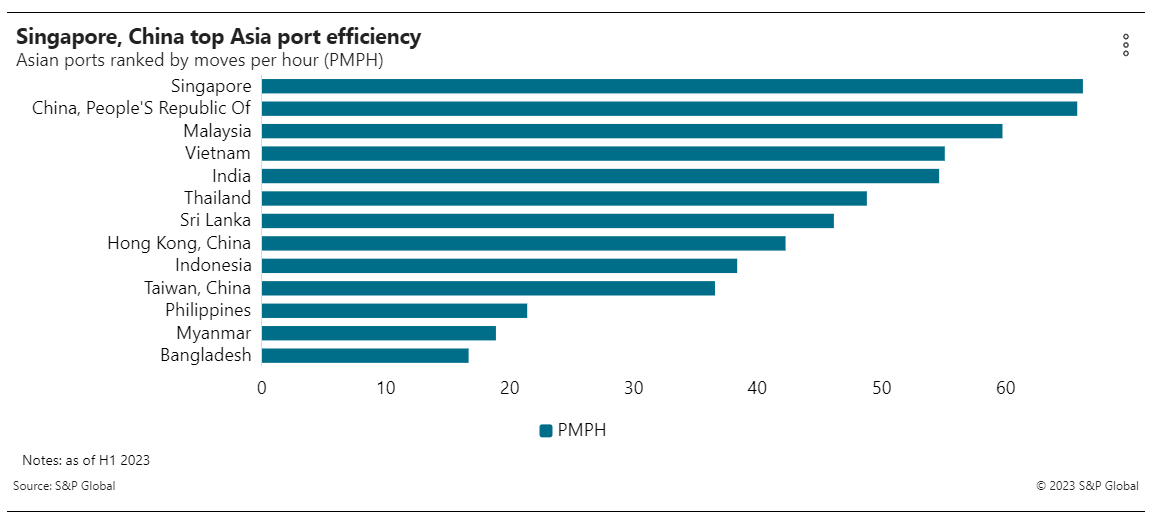
One example of divergent levels of efficiency is berth productivity, measuring how quickly terminals load and offload ships. China and Singapore have the most productive ports in the region, with ports in other countries, including the Philippines, Myanmar and Bangladesh generating substantially lower productivity, contributing to vessel delays and larger supply chain disruption, according to Port Performance data from S&P Global, parent company of the Journal of Commerce.


“Building redundancy into supply chains isn’t costless,” economist Marc Levinson, author of The Box and a scheduled TPM24 speaker, told the Journal of Commerce. “If a manufacturer makes a product in two or three countries rather than in one location, it may lose economies of scale, and its supply chain logistics get more complicated.”